
Jain & Iyer
Case study by Vishal Sahani
Translating individual purchases and scheduled society orders into one commerce experience.
- Next.js
- Node.js
- Razorpay
- Tailwind CSS
- GCP
The challenge
Jain & Iyer is a batters, flours, and instant-premix brand serving individual customers and residential societies. Those customers share a product catalogue, but not an ordering routine. Individual purchases follow a direct ordering journey; society purchases need to fit fixed weekly delivery days, cutoff times, and coordinated dispatch.
Checkout needed to make those differences understandable: customers need a clear delivery date, while the business needs orders organized around its delivery schedule.
Two ways to order
The platform keeps individual and society ordering distinct without treating them as separate products. The chosen ordering model determines the relevant pricing and delivery information, so customers can understand the conditions of their purchase before completing checkout.
The society is also an operational grouping. Society-specific pricing serves customers, while grouped orders give the delivery operation a shared destination for dispatch.
- Individual orders follow a direct doorstep-delivery journey.
- Society orders follow predefined weekly delivery days.
- Society-specific pricing accompanies society-grouped orders.
Business rules before screens
Each society's delivery days and cutoff times define when an order can be fulfilled. The application checks those rules and automatically assigns the next valid delivery date when an order arrives after the cutoff, rather than leaving the customer to interpret the schedule.
These rules connect checkout to dispatch. Administrative overrides provide room for schedule changes without disrupting existing orders, keeping operational adjustments distinct from the normal date-assignment flow.
- Check the society's delivery days and order cutoff.
- Assign the next valid delivery date after the cutoff.
- Group orders by society for dispatch.
- Allow administrative schedule overrides without disrupting existing orders.
Designing for repeat use
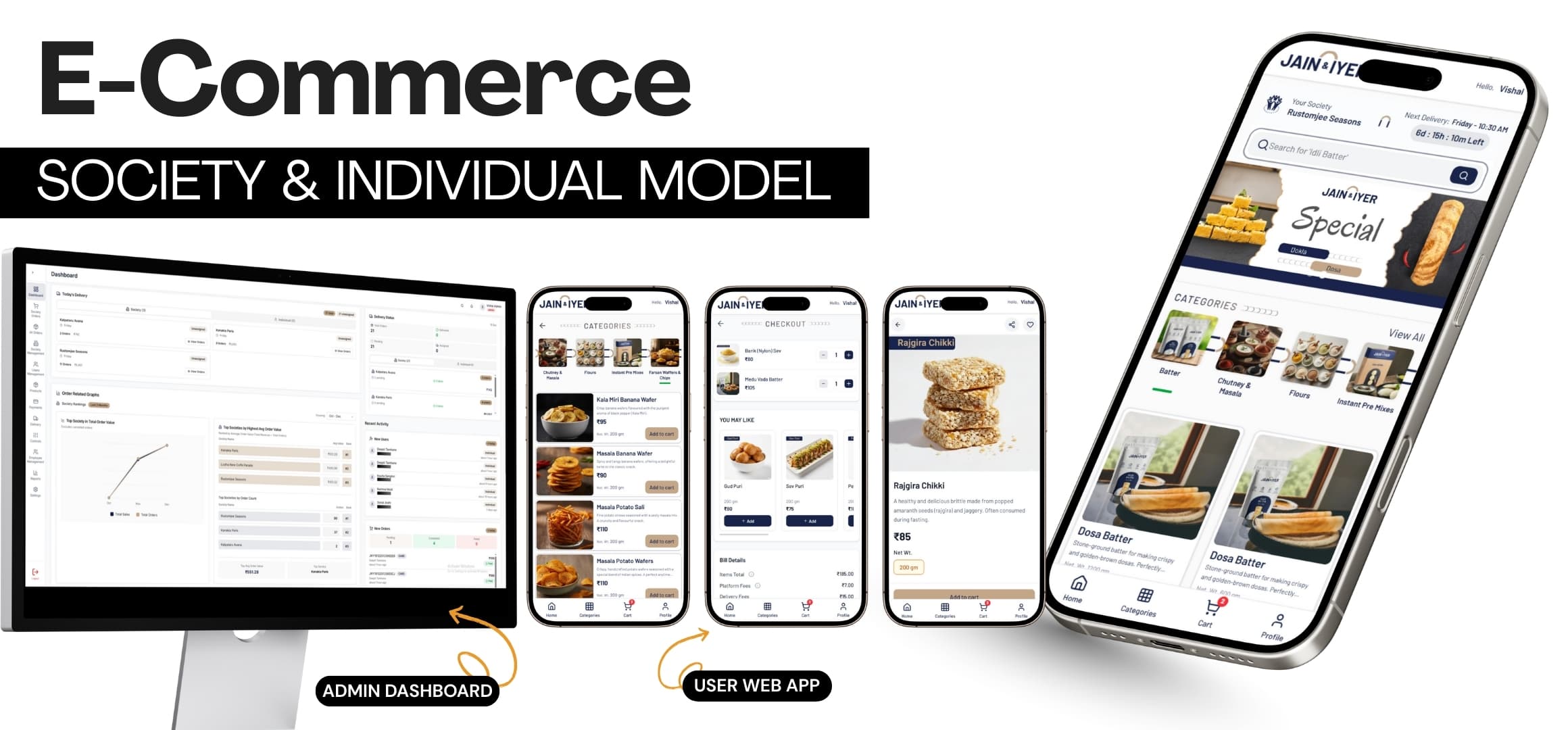
User journeys and wireframes helped structure the different paths through the product. The customer-facing design focuses on repeat ordering: a clear starting choice, mobile-first browsing, and checkout steps that keep attention on the purchase rather than the scheduling rules behind it.
Visible delivery dates connect the shopping flow to the weekly delivery model. Customers can see when an order fits the schedule as part of their buying decision.
- Distinguish individual and society ordering early.
- Keep mobile checkout focused.
- Show delivery dates and scheduling information clearly.
Control behind the scenes
The administrative experience brings society setup, products, inventory, and orders into the same operation. Customer, administrative, and delivery responsibilities stay distinct: customers place purchases, administrators manage the catalogue and schedules, and delivery work uses society-grouped orders for dispatch.
Catalogue and schedule controls sit alongside order management, connecting what customers can buy with how the business prepares deliveries.
- Create societies with delivery days and cutoffs.
- Manage products and inventory.
- Review society-grouped orders for dispatch.
- Apply schedule overrides when needed.
Connecting the system
Next.js provides the customer-facing frontend, while Node.js supports application logic, including ordering and scheduling. Razorpay connects payments, Tailwind CSS supports the interface styling, and Google Cloud Platform provides hosting. The system also includes a notification integration.
These pieces support the path from customer ordering to operational handling. The delivery rules connect the frontend purchase journey with administrative scheduling and society-grouped dispatch.
What the product enables
One system handles individual purchases and scheduled society orders without hiding their differences. Customers see the ordering context and delivery date; the business works with grouped orders and controls products, inventory, and schedules.
The design lesson is practical: define the business rules before simplifying the screens. Here, a focused shopping experience depends on representing the delivery workflow clearly, not removing it from view.